
Introduction
On the surface, it can look beautiful:
A mother who does everything for her child,
always present, always available, always deciding, always protecting.
A father who intervenes in every conflict,
writes the emails to teachers, negotiates with friends’ parents, manages every challenge, and says:
“I just don’t want my child to suffer like I did.”
From a distance, this can look like deep love and devotion.
And sometimes, it truly is.
But in many cases, beneath this devotion lies a pattern we call:
over-involvement or enmeshment and on the child’s side, dependency.
In this dynamic, the child:
- feels they cannot decide without the parent
- fears upsetting or disappointing the parent
- takes emotional responsibility for the parent’s mood
- struggles to know what they want, apart from the parent
This article explores, through the lens of attachment theory and family systems:
- What is the difference between healthy and unhealthy dependence?
- Who is an over-involved parent and why do they become that way?
- How does a dependent child think, feel, and behave?
- What are the long-term consequences of enmeshment?
- How can families move towards healthier, more secure boundaries without losing closeness?
Healthy Attachment vs. Unhealthy Dependency
Healthy Attachment
In secure attachment, the child learns:
- “My parent is my safe base.”
- “I can go out into the world, explore, and come back.”
- “I can say no, and I am still loved.”
- “I can make mistakes and the relationship survives.”
Closeness and independence grow together.
Unhealthy Dependency / Enmeshment
In enmeshment, the emotional boundary between parent and child is blurred:
- The child feels responsible for the parent’s happiness
- The parent’s moods dominate the emotional climate
- The message is: “We must always be close separation is betrayal.”
- The child’s autonomy is subtly framed as selfishness or ingratitude
Common messages in such families include:
“You are all I have.”
“I live only for you.”
“If you are unhappy, my life is meaningless.”
These sentences may sound loving,
but they place a heavy emotional burden on the child:
“If I separate, if I grow, if I say no you will collapse.”
Who Is the Over-Involved Parent?
An over-involved parent is not a “bad” parent.
In fact, they often:
- love intensely
- sacrifice a lot
- feel deeply responsible
- are highly sensitive to their child’s pain
But they:
- struggle to see the child as a separate person
- merge the child’s life with their own
- use the child unconsciously as a source of meaning, stability, or emotional soothing
Common traits of over-involved parents
- Difficulty tolerating the child’s discomfort or frustration
- A strong urge to “fix” everything quickly
- Intense worry about the child’s safety or success
- Involvement in every decision (friends, school, career, interests)
- Guilt when the child feels upset
- Little time or space for their own life outside the parenting role
Often, behind this pattern, we find:
- the parent’s own history of insecure attachment
- experiences of abandonment, betrayal, or loss
- cultural scripts glorifying self-sacrificing parenthood
- loneliness in adult relationships (using the child as an emotional partner)
The parent usually does not intend harm.
They are trying to protect.
But in doing so, they unintentionally prevent the child’s emotional independence.
What Does a Dependent Child Look Like?
In childhood (ages ~3–8)
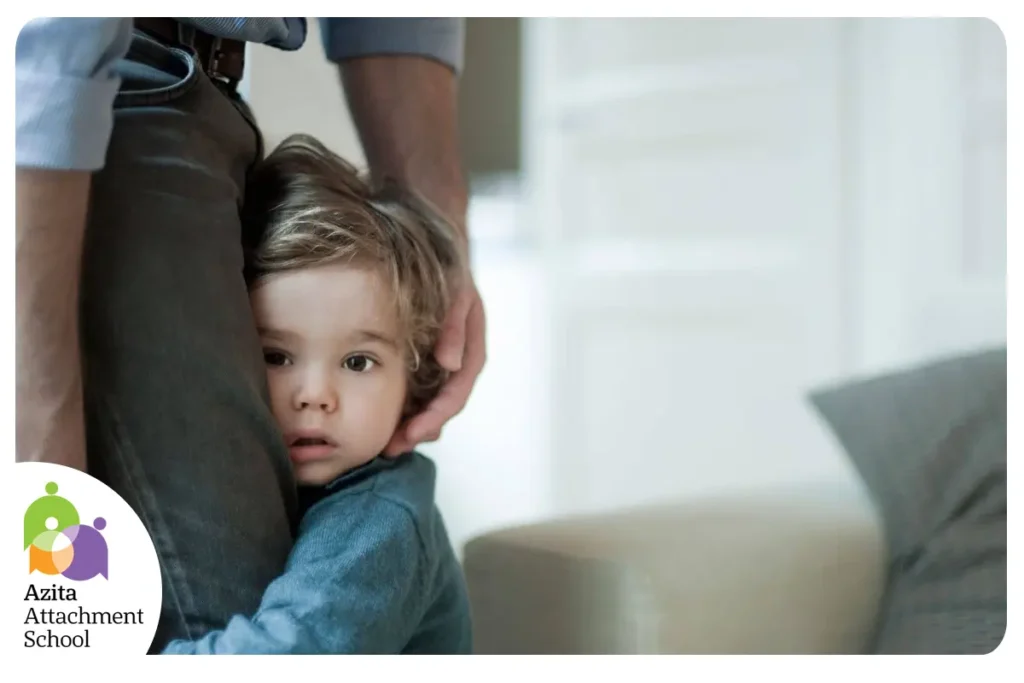
- Separation from the parent is very difficult
- The child needs constant reassurance: “Will you be there?”
- Refuses to try new situations without the parent
- Waits for the parent’s approval before making small choices
In preadolescence and adolescence
- Asks for advice about almost everything
- Fears saying “no” to the parent
- Takes on emotional roles (“Mom, don’t be sad, Dad didn’t mean it.”)
- Oscillates between clinging and anger
- Struggles to define personal preferences, values, and limits
Internal beliefs often include:
- “If I disappoint you, I’m a bad person.”
- “I must take care of you; you need me.”
- “My job is to keep the peace and not cause trouble.”
The Systemic and Attachment Roots of Enmeshment
Salvador Minuchin, in structural family therapy, described enmeshment as:
a pattern where family members are overly involved in each other’s lives, with diffuse boundaries and limited autonomy.
In enmeshed families:
- closeness is confused with emotional fusion
- children may become emotional partners or confidants to parents
- individuality is seen as a threat to family unity
Attachment theory deepens this by showing that:
- parents with insecure or disorganized early attachments
- or with unresolved trauma or loss
may unconsciously say to their child:
“I won’t let you feel what I felt: alone, unseen, abandoned.
So I will be everywhere.
And you will be everything to me.”
The tragic part is that:
in trying to protect the child from loneliness,
the parent may instead prevent the child from forming a solid self.
Long-Term Consequences for the Child
In the short term, such children may look:
- polite
- cooperative
- “mature for their age”
- attached and caring
But long-term, they often face:
- difficulty making independent decisions
- fear of disappointing others
- chronic guilt when setting boundaries
- vulnerability to codependent romantic relationships
- problems saying no
- confusion about personal identity (“What do I want?”)
- burnout from excessive emotional caretaking
As adults, they may:
- become over-involved parents themselves
- or join relationships where they are either controlled or controlling
The Role of Culture
In many collectivist cultures, including Iranian culture, common messages include:
“Family comes before everything.”
“A good child sacrifices for their parents.”
“Parents are sacred; you must always put them first.”
These beliefs are deeply woven into identity.
But when combined with unprocessed trauma or loneliness in parents,
they can justify enmeshment and make healthy boundaries look selfish or disrespectful.
The child receives a double message:
“If you separate, you are betraying us.
If you stay fused, you are a good child but you may lose yourself.”
How Can This Pattern Be Healed?
The good news:
Enmeshment is not a life sentence.
Patterns can change
but the change must begin with the parent, not the child.
1. Parental self-awareness
Key questions for parents:
- “Have I made my child the center of my emotional life?”
- “Do I feel empty or anxious when they separate or say no?”
- “Do I have a sense of self beyond being a parent?”
- “Do I often expect my child to comfort or support me emotionally?”
The goal is not self-blame,
but curious, compassionate awareness.
2. Building soft, clear boundaries
Healthy boundaries sound like:
“I love you deeply, and I am also a separate person.”
Examples:
- “I can help you think about it, but the final decision is yours.”
- “I’m tired now; we can talk after I rest.”
- “I care about your feelings, but I can’t always fix everything.”
Boundaries protect both the child and the parent.
3. Allowing frustration and imperfection
A child who never experiences frustration
never discovers their own resilience.
Instead of instantly rescuing, the parent can say:
“I see it’s hard. I’m here with you.
I trust that you can handle this, and I’ll support you if needed.”
This honors both the child’s feelings
and their capacity.
4. Separating emotional responsibilities
The child is not responsible for:
- the parent’s marriage
- the parent’s loneliness
- the parent’s self-worth
- the parent’s happiness
A healing message might be:
“Your presence adds joy to my life,
but you are not responsible for my happiness.
That’s my job as an adult.”
This frees the child from invisible chains of guilt.
5. Seeking professional support
When patterns are strong
or when there is significant trauma or guilt
working with an attachment-based therapist or family therapist can provide:
- a safe space to explore
- language for hidden dynamics
- practical steps toward healthier boundaries
This is not a sign of failure.
It is a commitment to breaking intergenerational cycles.
How the Child Benefits from Healthier Boundaries
As parents gradually step out of over-involvement:
- the child learns to recognize their own feelings and needs
- autonomy no longer feels like betrayal
- guilt reduces when they say no or choose differently
- relationships become more balanced
- in adolescence, they are less likely to either cut off completely or stay fused but resentful
Healthy attachment does not mean:
“We are always merged.”
It means:
“You are free to be you, and I am here.
Our bond is strong enough to handle your separateness.”
Conclusion
Over-involvement and unhealthy dependency often grow out of love
but a love tangled with fear, loneliness, and unhealed wounds.
When a parent starts to say:
“I love you,
and I will not use you to heal my own pain,”
a new relationship becomes possible:
one where closeness and freedom coexist,
and where the child can grow into an adult
who knows how to love
without losing themselves.
References
Bowen, M. (1978). Family therapy in clinical practice. Jason Aronson.
Carter, B., & McGoldrick, M. (Eds.). (2005). The expanded family life cycle: Individual, family, and social perspectives (3rd ed.). Allyn & Bacon.
Johnson, S. M. (2019). Attachment theory in practice: Emotionally focused therapy (EFT) with individuals, couples, and families. Guilford Press.
Minuchin, S. (1974). Families and family therapy. Harvard University Press.
Siegel, D. J., & Bryson, T. P. (2020). The power of showing up: How parental presence shapes who our kids become and how their brains get wired. Ballantine Books.
Wallin, D. J. (2007). Attachment in psychotherapy. Guilford Press.