
Introduction
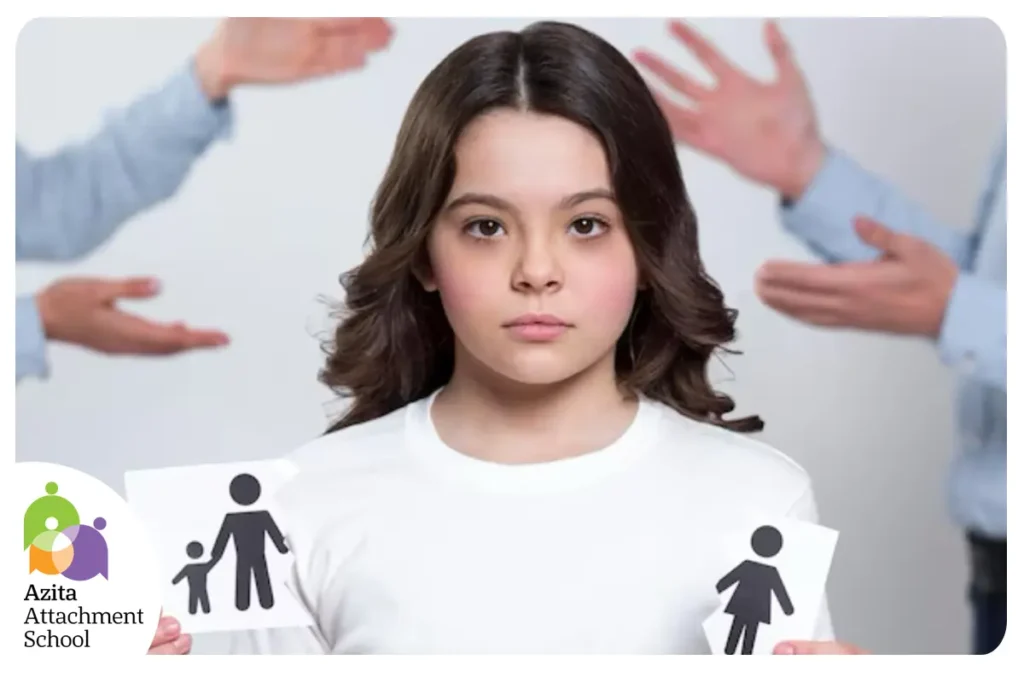
For a child, divorce often feels like an earthquake:
the “one family” they knew splits into two homes, two routines, two worlds.
Many parents quietly fear:
“Have we ruined our child’s life?”
“Will our child be broken forever because we separated?”
Research paints a more nuanced picture:
- Divorce itself does not automatically damage a child beyond repair.
- What most harms children is chronic, intense conflict, instability, and loyalty battles—both before and after the legal divorce (Amato, 2010; Kelly & Emery, 2003).
The hopeful truth is:
A child who has at least one emotionally stable, predictable, and caring parent can still develop secure attachment and a healthy sense of self, even after parental separation.
This article explores:
- how children of different ages experience divorce
- what behaviors are most harmful to their emotional security
- and how parents can remain a “secure base” after divorce—
even when the marital relationship has ended.
How Children Experience Divorce
Children do not experience divorce in legal terms.
They experience it as a shift in their attachment landscape:
- “Am I losing one of you?”
- “Is this my fault?”
- “If you stopped loving each other, could you stop loving me too?”
- “Do I have to choose between you?”
For a child, the deepest fear is not paperwork.
The deepest fear is abandonment and divided loyalty.
Age-Specific Reactions
Young children (approx. 3–6 years)
- Have limited understanding of abstract concepts like divorce.
- Interpret separation as “Mommy/Daddy left.”
- Often show regression: bedwetting, clinginess, tantrums.
- Frequently blame themselves (“Maybe they fought because I was bad.”).
School-age children (7–12 years)
- Understand that divorce is a change in family structure.
- May feel intense sadness, anger, and shame.
- Compare themselves to peers with “intact” families.
- Might split parents into “good” and “bad,” especially if exposed to parental conflict.
Teenagers
- Reflect more on morality, loyalty, and identity.
- May feel betrayed, cynical, or disillusioned about relationships.
- Can ally strongly with one parent or act emotionally numb.
- Are at higher risk for acting out, romantic entanglements, or parentification (trying to rescue a parent).
Across all ages, one theme is crucial:
Children are deeply harmed when they feel forced, directly or indirectly, to take sides.
What Hurts Children Most After Divorce?
Studies consistently show that the following factors intensify distress (Amato, 2010; Emery, 2012):
- Ongoing high conflict between parents, especially in front of the child.
- Chronic badmouthing of the other parent, inviting the child into an alliance.
- Unpredictable schedules and unstable caregiving, changing plans frequently.
- Emotional unavailability, where the parent is physically present but emotionally collapsed.
- Using the child as a messenger, spy, or therapist.
- Blocking a healthy relationship with the other parent, except in cases of abuse or severe risk.
In contrast, children do far better when they have at least one secure, emotionally present parent, even if the other parent is inconsistent.
An Attachment Perspective: Secure Parenting After Divorce
Attachment theory tells us:
Children do not need perfect parents.
They need “good-enough” secure parents who are:
- emotionally available
- consistent
- responsive
- willing to repair when things go wrong
After divorce, the central question becomes:
“Can my child still count on me as a safe base?”
Even if:
- the custody arrangement is not ideal
- the other parent is difficult to cooperate with
- the legal process is stressful
the way you show up still has enormous protective power.
Common Mistakes Parents Make After Divorce
1. Turning the child into a confidant
Sharing adult details infidelity, financial disputes, legal strategies
places the child in a role they are not equipped to handle.
2. Asking the child to judge
Questions like:
“Who do you think was right?”
“Don’t you agree your father/mother was unfair?”
force the child into an impossible position and deepen loyalty conflicts.
3. Competing to be the “favorite parent”
- excessive gifts
- no rules or boundaries
- undermining the other parent
This may win short-term approval but undermines long-term security and respect.
4. Using the child as a messenger
“Tell your mom she still owes me money.”
“Tell your dad I’m not okay with that schedule.”
This makes the child carry emotional and relational burdens that belong to the adults.
Core Principles of Secure Parenting After Divorce
Principle 1: The child must not choose sides
The central emotional message should be:
“You don’t have to choose between us.
You are allowed to love both of us.”
Even when you feel hurt or angry at your ex-partner,
protecting your child’s right to love both parents is a powerful act of emotional leadership.
Principle 2: Predictability and structure
Children cope better with:
- consistent routines
- clear expectations
- reliable transitions between homes
Both homes do not have to be identical,
but they should be coherent enough that the child is not constantly disoriented.
Principle 3: Maintaining parent–child boundaries
Your child is:
- your child
- not your friend, therapist, or partner.
They can see that you are sad,
but they must not feel responsible for fixing your sadness.
Principle 4: Allowing grief and anger
A child has the right to:
- be sad about the divorce
- miss the other parent
- be angry at both of you
- ask hard questions
Secure parents do not sugarcoat divorce as “no big deal,”
but they also do not collapse under the child’s pain.
A balanced message might be:
“Yes, this is hard.
I know your heart is hurting, and mine too.
You are allowed to feel whatever you feel,
and I am here with you in it.”
Principle 5: Taking care of yourself
If you are chronically exhausted, depressed, or flooded with rage,
your child cannot fully relax even in “your” time.
Self-care is not selfish;
it is part of responsible parenting after divorce:
- therapy
- support groups
- friendships
- rest
- boundaries with your ex
A more regulated parent = a more secure child.
Co-Parenting: Staying Parents Even When You’re No Longer Partners
In the best scenarios, co-parenting means:
- Basic respect in communication
- Sharing essential information about the child (health, school, behavior)
- Not involving the child in disputes
- Flexibility when needed, within reason
Co-parenting does not require friendship or emotional intimacy.
It requires shared focus on the child’s well-being.
When the other parent is unwilling or unable to cooperate,
a realistic goal becomes:
“I will handle my part in the healthiest, most stable way possible,
and minimize the impact of the conflict on my child.”
When to Seek Professional Help
Consider involving a mental health professional if:
- conflict between parents is intense and persistent
- the child shows signs of severe anxiety, depression, regression, or aggression
- the child becomes parentified (caring for your emotions)
- you feel stuck in guilt, rage, or helplessness
Child therapists, attachment-informed family therapists, or specialized divorce counselors
can help prevent temporary stress from becoming long-term trauma.
Conclusion
Divorce inevitably brings pain.
But pain is not the same as permanent damage.
What shapes a child’s future is not simply that their parents divorced,
but how their parents behaved during and after the divorce.
When at least one parent remains:
- emotionally present
- predictable
- non-punitive
- respectful of the child’s bond with the other parent
the child can still grow into an adult who trusts, loves, and forms stable relationships.
Being a secure parent after divorce does not mean never making mistakes.
It means returning, repairing, and reminding your child—through your actions—
“Our marriage ended.
اما والدگری ما تمام نشده.
I am still your safe base.
I am not going anywhere.”
References
Amato, P. R. (2010). Research on divorce: Continuing trends and new developments. Journal of Marriage and Family, 72(3), 650–666.
Emery, R. E. (2012). Renegotiating family relationships: Divorce, child custody, and mediation (2nd ed.). Guilford Press.
Kelly, J. B., & Emery, R. E. (2003). Children’s adjustment following divorce: Risk and resilience perspectives. Family Relations, 52(4), 352–362.
Lamb, M. E. (Ed.). (2012). Mother-child and father-child relationships in diverse contexts. Routledge.
Neff, L. A., & Cooper, C. E. (2004). Parental conflict and children’s adjustment following divorce: The protective role of parenting. Journal of Marriage and Family, 66(1), 113–128.
Siegel, D. J., & Bryson, T. P. (2018). The power of showing up: How parental presence shapes who our kids become and how their brains get wired. Scribe Publications.