

Introduction
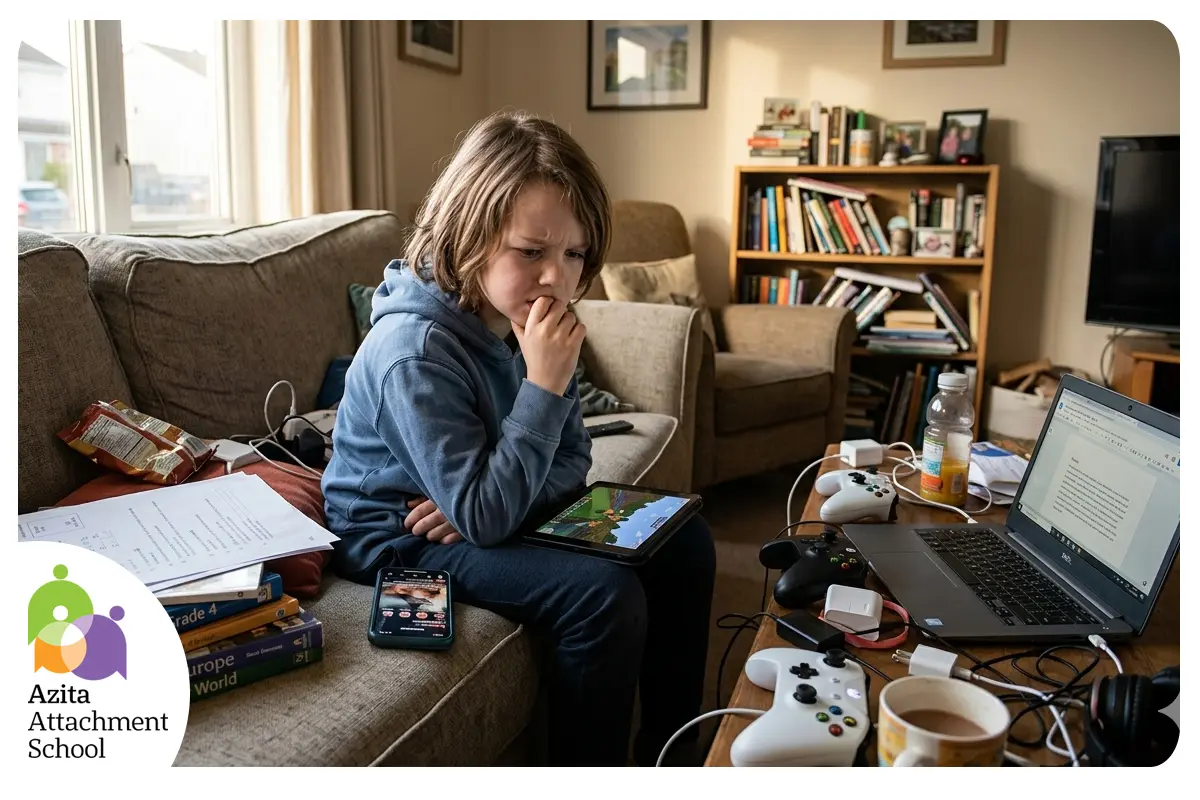
Many parents today feel that their children are more anxious than previous generations.
A child struggles to fall asleep.
A teenager gets stomachaches before exams.
A young child repeatedly asks, “What if something bad happens?”
Another child appears successful, but lives with constant internal pressure.
Anxiety in children does not always look like obvious fear.
It may appear as:
- perfectionism
- irritability
- sleep difficulties
- stomachaches
- avoidance
- emotional outbursts
- dependence
- or excessive screen use
The question is:
Why do children today seem more anxious?
The answer is not simple.
Today’s children are growing up in a world of high stimulation, academic pressure, digital comparison, reduced free play, parental anxiety, global uncertainty, and less predictable emotional rhythms.
This article explores child anxiety through the lens of attachment, neuroscience, and nervous system regulation.
1. What Is Anxiety in Children?
Anxiety is not the same as fear.
Fear usually has a clear object:
a dog, a loud sound, a stranger.
Anxiety is more diffuse.
The child may not know exactly what they are afraid of,
but their body remains in a state of alert.
An anxious child’s nervous system keeps asking:
“Am I safe?”
“Can I handle this?”
“What if something goes wrong?”
“Will I still be loved if I fail?”
When these questions become constant,
the child begins to live in prediction mode rather than presence.
2. Why Are Children More Anxious Today?
1. Overstimulating Environments
Children today are exposed to:
- screens
- fast videos
- notifications
- loud environments
- constant information
- and visual overload
The developing brain is not built for continuous stimulation.
Children need rhythm, silence, free movement, and human connection.
Without these, the nervous system forgets how to return to calm.
2. Less Free Play
Free play is one of the most powerful tools for emotional regulation.
Through play, children:
- test limits
- experience manageable risk
- build imagination
- tolerate frustration
- and practice problem-solving
But many children today live highly scheduled lives:
school, homework, lessons, screens, organized activities.
When free play decreases,
children lose opportunities to build resilience.
3. School Pressure and Achievement Culture
For many children,
achievement has become tied to identity.
They learn:
“If I succeed, I am valuable.”
“If I fail, I disappoint people.”
“If I am not the best, I am not enough.”
Even when parents do not say these things directly,
children absorb them through tone, comparison, and emotional reactions.
This creates the successful but anxious child.
4. Social Media and Constant Comparison
Even children who are not highly active online live inside a culture shaped by comparison.
Young people are exposed early to:
- beauty standards
- popularity metrics
- lifestyle comparison
- academic competition
- body image pressure
This leads to identity-based anxiety:
“Am I enough?”
“Am I liked?”
“Am I behind?”
“Do I belong?”
5. Parental Anxiety
One of the most overlooked sources of child anxiety is parental anxiety.
Children do not only listen to what parents say.
They read parents’ bodies.
If a parent is constantly:
- worried
- tense
- catastrophizing
- afraid of mistakes
- or emotionally reactive
the child learns:
“The world is unsafe.”
Anxiety is transmitted through tone, facial expression, speed, and emotional climate.
3. Anxiety Through the Lens of Attachment
Attachment theory tells us that children need a secure base.
A secure base means:
- “When I am scared, someone is there.”
- “When I make mistakes, I am not rejected.”
- “When I feel overwhelmed, I am not alone.”
- “I can explore the world and return to safety.”
When children have this emotional base,
they can face stress with greater resilience.
But when parents are:
- unpredictable
- overcontrolling
- emotionally unavailable
- or afraid of the child’s feelings
the child’s anxiety increases.
An anxious child often tries to control the outside world because they do not feel safe inside.
4. Signs of Anxiety in Children and Teens
Anxiety can show up in many ways.
Physical signs
- stomachaches
- headaches
- nausea
- racing heart
- sleep problems
- fatigue
Behavioral signs
- clinginess
- school refusal
- procrastination
- irritability
- avoidance
- reassurance-seeking
Cognitive signs
- repetitive thoughts
- fear of mistakes
- catastrophizing
- self-doubt
- overthinking
Emotional signs
- shame
- restlessness
- sadness
- emotional sensitivity
- frustration
In teens, anxiety may hide behind:
- numbness
- excessive sleep
- phone addiction
- withdrawal
- or sarcasm.
5. How Parents Accidentally Increase Anxiety
1. Excessive reassurance
When children repeatedly ask:
“Are you sure nothing bad will happen?”
parents often answer over and over.
But constant reassurance can strengthen anxiety,
because the child learns:
“I cannot calm down unless someone guarantees safety.”
A better response:
“I see that your worry is loud right now.
Let’s help your body feel safer.”
2. Rescuing too quickly
When parents remove every challenge,
children lose the chance to discover:
“I can handle hard things.”
Support is not the same as rescue.
3. Catastrophizing
Statements like:
“What if you fail?”
“Be careful, something could go wrong.”
“Are you sure you can handle it?”
keep the child’s nervous system in threat mode.
4. Comparison
Comparison intensifies anxiety because it teaches the child that worth is relative.
6. How to Help an Anxious Child
1. Body first, logic second
An anxious child cannot think clearly until the body settles.
Start with:
- slow breathing
- soft tone
- safe touch
- walking
- water
- reduced stimulation
Once the body calms,
conversation becomes possible.
2. Name the emotion
Say:
“You seem worried.”
“Your body is telling you something feels unsafe.”
“I wonder if you’re afraid of making a mistake.”
Naming emotion gives the child a map.
3. Build frustration tolerance
Children need repeated experiences of:
“This is hard, and I can handle it.”
Parents can say:
“I know this is uncomfortable.
I’ll stay with you while you take the first step.”
4. Reduce performance pressure
Focus on effort, process, and courage rather than outcome.
Instead of:
“You got the best grade.”
Say:
“I saw how much effort you put in.”
“You kept going when it was hard.”
“Mistakes are part of learning.”
5. Create rhythm and predictability
Anxious children calm down with structure:
- consistent sleep
- regular meals
- screen-free time
- family rituals
- predictable routines
Predictability tells the nervous system:
“You are safe.”
6. Bring the body back into real life
Children need:
- movement
- nature
- play
- creativity
- real relationships
not only digital distraction.
Even twenty minutes of outdoor play can help regulate the nervous system.
7. The Role of the Secure Parent
A secure parent cannot remove all anxiety from a child’s life.
But they can become the place where the child’s body learns to breathe.
A secure parent:
- does not mock feelings
- does not rush regulation
- does not respond to anxiety with control
- does not treat mistakes as disasters
- repairs after conflict
The child learns:
“The world may be hard,
but I am not alone.”
Conclusion
Children today are growing up in a world that is fast, competitive, stimulating, and uncertain.
It makes sense that anxiety is rising.
But child anxiety is not only a problem inside the child.
It is a message about:
- environment
- pace
- pressure
- relationships
- and nervous system safety.
The solution is not only teaching calming techniques.
The deeper solution is creating a home where the child’s body can come down from alert.
A home where the child knows:
“I do not need to be perfect to be loved.”
“I do not need to control everything to be safe.”
“When I am afraid, someone stays with me.”
That is how secure attachment helps calm an anxious generation.
References
- Cassidy, J., & Shaver, P. R. (2016). Handbook of attachment: Theory, research, and clinical applications (3rd ed.). Guilford Press.
- Eisenberg, N., Spinrad, T. L., & Eggum, N. D. (2010). Emotion-related self-regulation and its relation to children’s maladjustment. Annual Review of Clinical Psychology, 6, 495–525.
- Ginsburg, K. R. (2007). The importance of play in promoting healthy child development and maintaining strong parent-child bonds. Pediatrics, 119(1), 182–191.
- Siegel, D. J. (2015). The developing mind: How relationships and the brain interact to shape who we are (2nd ed.). Guilford Press.
- Twenge, J. M. (2017). iGen: Why today’s super-connected kids are growing up less rebellious, more tolerant, less happy, and completely unprepared for adulthood. Atria Books.
- Van der Kolk, B. A. (2014). The body keeps the score: Brain, mind, and body in the healing of trauma. Viking.




دیدگاه خود را بنویسید