

Introduction
If you watch a group of children in a frustrating situation – someone cuts the line, a toy is taken, a game feels unfair – you will see very different responses:
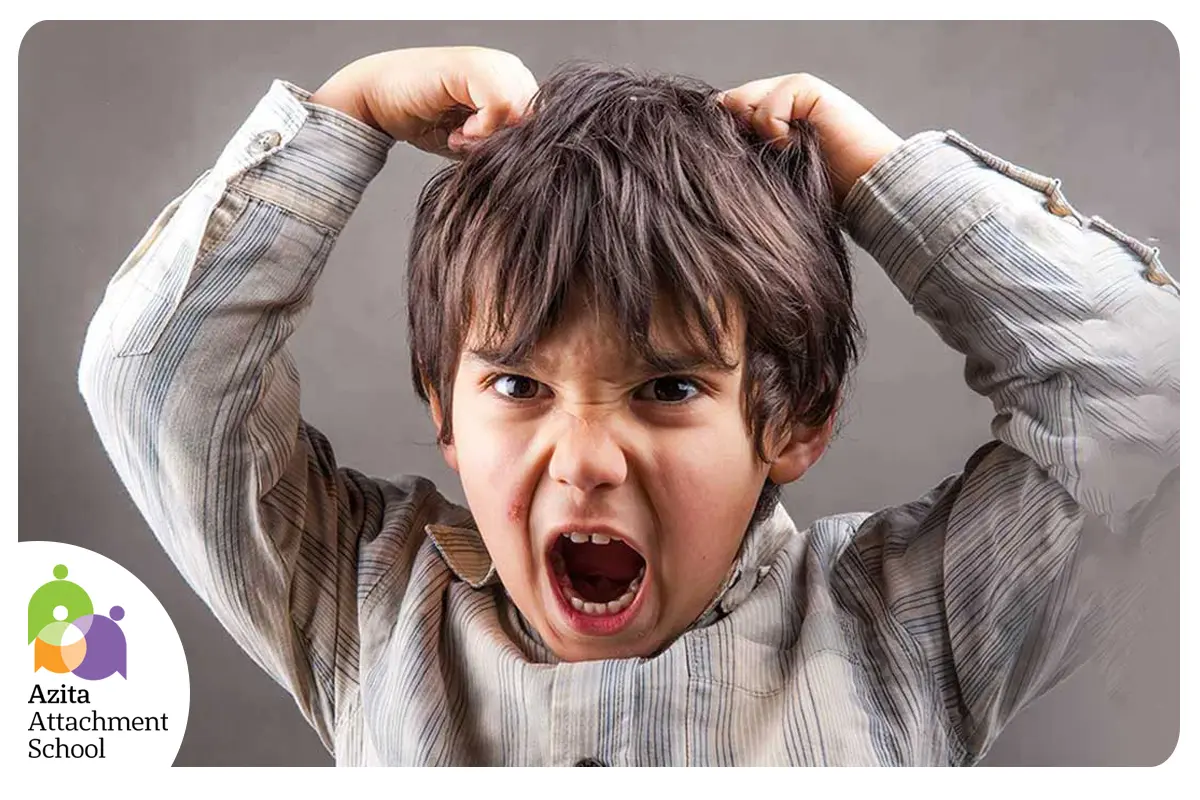
One child screams, hits, throws, or kicks.
Another child gets very quiet, looks away, and whispers, “It’s fine,” while their eyes fill with tears.
Parents often ask:
“Why does my child explode so quickly?”
or
“Why does my child never speak up, just swallow everything?”
These are not random personality quirks.
They are shaped by three interconnected layers:
- The child’s developing brain and nervous system
- Early attachment experiences and co-regulation with caregivers
- The child’s temperament and sensitivity
In this article, drawing on attachment theory, affective neuroscience, and emotion regulation research, we explore what anger means in children, why some externalize and some internalize, and how parents can turn anger from an enemy into a pathway to connection.
What Is Childhood Anger Really About?
From an attachment perspective, anger is not a “bad” emotion.
Anger is the nervous system’s way of saying:
“Something feels wrong. I need protection or change.”
Children become angry when they:
- Feel treated unfairly
- Feel unseen or dismissed
- Experience sudden loss or disappointment
- Feel threatened, shamed, or powerless
When this happens, the body moves into survival mode. Three common patterns appear:
- Fight → explosive anger
- Flight → avoidance, running away
- Freeze or fawn → shutting down, pleasing others
So anger is not the problem by itself.
The real issue is when the child is left alone with anger – without a calm adult to help them understand, contain, and regulate it.
Two Main Anger Styles: The “Exploder” and the “Imploder”
A. The Explosive Child (Externalized Anger)
These children, when upset, tend to:
- Yell, scream, or hit
- Throw objects
- Kick, push, or break things
- Go from 0 to 100 in seconds
Their nervous system moves quickly into fight mode.
Research shows that in many of these children:
- The amygdala is highly reactive
- The prefrontal cortex (the “brake system”) is still immature
- Frustration tolerance is low (Cole et al., 2004; Eisenberg et al., 2010)
If parents respond with more yelling, shaming, or harsh punishment, the child’s nervous system learns that the world is even more unsafe – and the explosions often intensify over time.
B. The Shut-Down Child (Internalized Anger)
These children, when upset, may:
- Go quiet
- Say “It’s okay” when it’s clearly not okay
- Avoid eye contact
- Blame themselves
- Change the subject with a nervous smile
Their nervous system leans toward freeze or fawn:
“Don’t fight, don’t run. Go still. Adapt. Disappear.”
On the surface, they seem “easy” or “mature”.
Inside, their anger and pain can accumulate and later show up as anxiety, depression, self-doubt, or even physical symptoms like stomachaches or headaches (Schore, 2012; Panksepp, 1998).
The Role of Attachment in Shaping Anger
Attachment theory suggests that children learn, in relationship with their caregivers:
- Whether emotions are allowed and survivable
- Whether someone will stay with them when they are overwhelmed
- Whether protest and anger are safe in the relationship
Briefly:
- Secure attachment: The child learns, “I can be angry and still be loved.” Anger is expressed and then repaired.
- Avoidant attachment: The child learns, “Strong feelings push people away.” They hide or minimize anger to stay close.
- Anxious/ambivalent attachment: The child often shows intense, prolonged anger mixed with clinginess and fear.
- Disorganized attachment: Anger is chaotic, alternating between aggression, collapse, and emotional numbness.
When caregivers respond to the child’s anger by:
- Mocking
- Minimizing (“It’s not a big deal”)
- Rejecting (“Go to your room”)
- Becoming frightening themselves
- Or emotionally collapsing
the child learns either to explode louder to be noticed, or to disappear emotionally to preserve the relationship.
What Happens in the Brain of an Angry Child?
In the heat of anger:
- The amygdala (alarm system) activates
- Stress hormones like cortisol rise
- The body prepares to fight or flee
- The prefrontal cortex (thinking, planning, empathy) temporarily goes offline
In this state, the child:
- Cannot process logic
- Cannot benefit from long explanations
- Cannot make meaningful promises about “next time”
What they need most is co-regulation:
a more regulated nervous system (the parent) staying close enough, calm enough, and kind enough for long enough that the child’s body can settle (Siegel, 2015).
How Parents Accidentally Make Anger Worse
Many well-intentioned parents unintentionally escalate anger by:
- Giving long lectures in the middle of a meltdown
- Shaming (“Look how ridiculous you are”)
- Threatening love withdrawal (“If you keep this up, I won’t talk to you”)
- Mirroring anger with anger (“You yell? I’ll yell louder”)
- Ignoring and hoping it will go away
These responses send the message:
“You are alone with your feelings.”
The explosive child responds by turning the volume up.
The shut-down child responds by turning the volume inward.
Supporting the Explosive Child
- Regulate yourself first
You cannot co-regulate if you are in fight mode too.
Take a breath. Slow your voice. Plant your feet on the ground. - Postpone teaching until after the storm
During the peak of anger, keep language short and simple:
“I see you’re really angry.”
“I’m here. I won’t let anyone get hurt.” - Combine empathy and limits
“I get that you’re furious. It feels unfair.
And I cannot let you hit.” - After the storm, help name feelings
“When they skipped your turn, did it feel unfair or embarrassing or both?” - Practice healthy outlets for anger
- Blowing “dragon breaths”
- Punching a pillow
- Running in the yard
- Drawing the “angry monster”
This teaches:
“Anger is allowed. Hurting yourself or others isn’t.”
Supporting the Shut-Down Child
- Don’t assume silence means all is well
“I’m okay” often means “I don’t feel safe enough to show my feelings.” - Offer presence without pressure
“I won’t force you to talk, but I’m here if you want company.” - Ask gentle, open-ended questions
“Was today a heavy day or a light day?”
“Did anything happen that stayed in your mind?” - Use play and creativity
Many shut-down children express more in play, drawing, or storytelling than in direct conversation. - Remove shame from the equation
Avoid labels like “too sensitive”, “dramatic”, or “cold”.
These deepen the child’s impulse to hide.
When to Seek Professional Help
It may be time to consult a child psychologist or attachment-informed therapist if:
- Anger is frequent, intense, and hard to manage
- The child regularly hurts themselves or others
- There has been a recent trauma (divorce, loss, migration, violence) and anger has escalated
- Anger is accompanied by sleep problems, regression, social withdrawal, or physical complaints
Seeking help is not a sign of parental failure.
It is a sign of courage and responsibility.
Conclusion
Anger in children is not a moral flaw.
It is a nervous system trying to cope and a heart trying to be heard.
Both the explosive child and the shut-down child are asking the same question in different languages:
“Will you stay with me when my feelings are big?”
The task of an attachment-informed parent is not to erase anger, but to show:
“Your anger can exist here, with me.
You don’t have to explode to be seen.
You don’t have to disappear to be loved.”
References
Cassidy, J., & Shaver, P. R. (Eds.). (2016). Handbook of attachment: Theory, research, and clinical applications (3rd ed.). Guilford Press.
Cole, P. M., Martin, S. E., & Dennis, T. A. (2004). Emotion regulation as a scientific construct: Methodological challenges and directions for child development research. Child Development, 75(2), 317–333.
Eisenberg, N., Spinrad, T. L., & Eggum, N. D. (2010). Emotion-related self-regulation and its relation to children’s maladjustment. Annual Review of Clinical Psychology, 6, 495–525.
Panksepp, J. (1998). Affective neuroscience: The foundations of human and animal emotions. Oxford University Press.
Schore, A. N. (2012). The science of the art of psychotherapy. W. W. Norton & Company.
Siegel, D. J. (2015). The developing mind: How relationships and the brain interact to shape who we are (2nd ed.). Guilford Press.
Thompson, R. A. (2016). Early attachment and later development: Familiar questions, new answers. In J. Cassidy & P. R. Shaver (Eds.), Handbook of attachment: Theory, research, and clinical applications (3rd ed., pp. 330–348). Guilford Press.




دیدگاه خود را بنویسید