Introduction
In today’s globalized world, many parents are raising children between two or more cultures a reality that brings both richness and complexity. While multicultural families often benefit from broader perspectives, stronger adaptability, and deeper empathy, they also face unique emotional challenges.
How can parents help their children embrace the new culture without losing touch with their roots?
How can a family maintain emotional connection when members are shaped by different cultural norms, languages, and values?
Research in cross-cultural psychology (Costigan & Dokis, 2006) shows that the ability to integrate two cultural identities rather than choosing one over the other is key to healthy development. Attachment theory (Bowlby, 1988) helps explain why: a secure child does not need to reject one world to belong to another. When emotional safety is present, cultural integration becomes a bridge rather than a battle.
The Challenges of Multicultural Parenting
Parents raising children in a multicultural context often walk a tightrope between preservation and adaptation. They want their children to stay connected to their heritage while also thriving in the dominant culture.
A father from an Iranian Canadian background, for example, may insist on speaking Farsi at home, while his child prefers to respond only in English the language of school, friends, and media. When the father reacts with shame or criticism (“You should be proud of your language!”), what was meant to preserve identity turns into conflict.
Studies on bicultural identity (Phinney & Ong, 2007) show that children develop stronger self-esteem and fewer behavioral conflicts when parents approach cultural differences with openness instead of fear. The goal is not to control which culture dominates, but to support the child in building an integrated sense of self that includes both worlds.
Language as Emotional Heritage
Language is not just a tool for communication it is the emotional DNA of a family. Speaking one’s mother tongue carries memories, emotions, and cultural wisdom that cannot be easily translated.
Neurolinguistic research (Pavlenko, 2012) indicates that emotions are encoded more deeply in a person’s first language. A parent’s affectionate words in their native tongue activate more emotional resonance than the same phrase spoken in a second language. Thus, when a parent stops using their mother tongue, an entire layer of emotional expression can fade away.
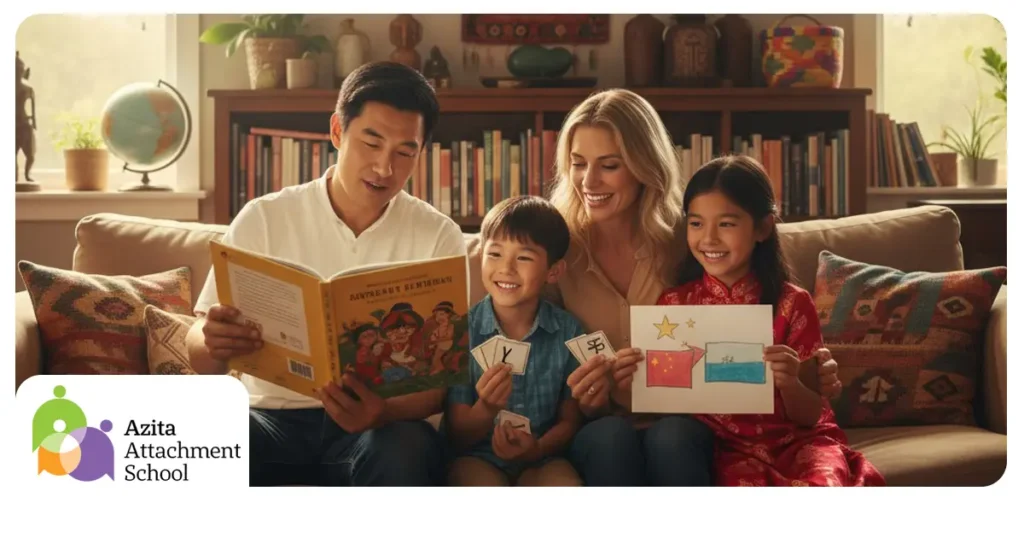
Introducing the heritage language at home through songs, games, and bedtime stories rather than through correction or punishment allows children to associate it with love, not pressure. A bilingual household is not a divided one; it is an emotionally layered home.
When Cultural Values Collide
Children growing up in multicultural environments often receive conflicting messages:
- At home, humility may be prized; at school, self-confidence is celebrated.
- Parents may emphasize respect and obedience; teachers may encourage questioning and independence.
Such contradictions can be confusing, but they are also opportunities for emotional growth. When parents use these moments as openings for dialogue rather than control, they teach flexibility and empathy.
Saying “In our culture, we do it this way what do you think about it?” Inviting curiosity instead of shame.
Daniel Siegel (2012) calls this integration: the ability to hold differences together without fragmentation. When parents model this balance, children internalize the message that they don’t have to choose between being “Canadian” or “Iranian” they can be both.
When Parents and Children Drift Apart Culturally
In many multicultural families, parents begin to feel that their children are “no longer like us.”
A mother might feel hurt when her teenager prefers Western music or avoids speaking the family’s native language. To her, this may feel like a rejection. To the teenager, it is simply adaptation a way of belonging among peers.
Conflict arises when difference is interpreted as disloyalty. The real challenge for parents is to stay emotionally connected even when values diverge. Research on adolescent attachment (Allen et al., 2021) shows that parents who respond to difference with curiosity instead of judgment maintain stronger trust and communication with their teens.
Belonging does not mean the same thing. A secure relationship gives the young person permission to explore without fear of losing love.
Building a Healthy Bicultural Identity
A healthy bicultural identity is not about splitting oneself in half; it’s about integrating multiple identities into a coherent whole. Children who can comfortably navigate between cultures tend to be more adaptable, creative, and resilient, but this integration requires intentional parenting.
Here are a few evidence-based strategies:
- Celebrate holidays and cultural events from both heritages.
- Encourage friendships across cultural boundaries.
- Speak openly about family roots and migration stories.
- Express pride in your heritage language while supporting the learning of the dominant language.
- Validate your child’s experiences of being “different” as normal and even enriching.
These simple acts signal to the child: You don’t have to choose one world. You belong to both.
Conclusion
Raising children in a multicultural and multilingual world requires emotional awareness, flexibility, and deep empathy. It challenges parents to examine their own identities to understand what they want to pass on, and what they can let go of.
Children who grow up in emotionally secure, culturally integrated homes do not feel torn between two worlds. They carry both the warmth of their heritage and the freedom of their new environment as part of a larger, richer self.
As attachment theory teaches, identity grows best in the soil of connection. When love transcends language and culture, roots and wings no longer compete; they coexist.
- Bowlby, J. (1988). A Secure Base: Parent-Child Attachment and Healthy Human Development.
- Siegel, D. (2012). The Developing Mind.
- Pavlenko, A. (2012). Emotion and bilingualism.
- Costigan, C. , & Dokis, D. P. (2006). Relations between parent–child acculturation differences and adjustment within immigrant Chinese families.
- Phinney, J. , & Ong, A. D. (2007). Conceptualization and measurement of ethnic identity: Current status and future directions.
- Allen, J. , et al. (2021). Parent–adolescent attachment and emotional adjustment in multicultural contexts.